Expertise

Well over a hundred years of this work. Current with the newest science and tools.

Six founding partners, one team across climate, water, agriculture, energy, AI, and financial risk. The people described below do your work and explain it, whether the room holds engineers, executives, or a board.

Founding partners

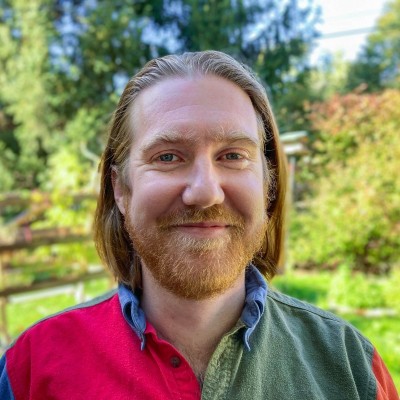
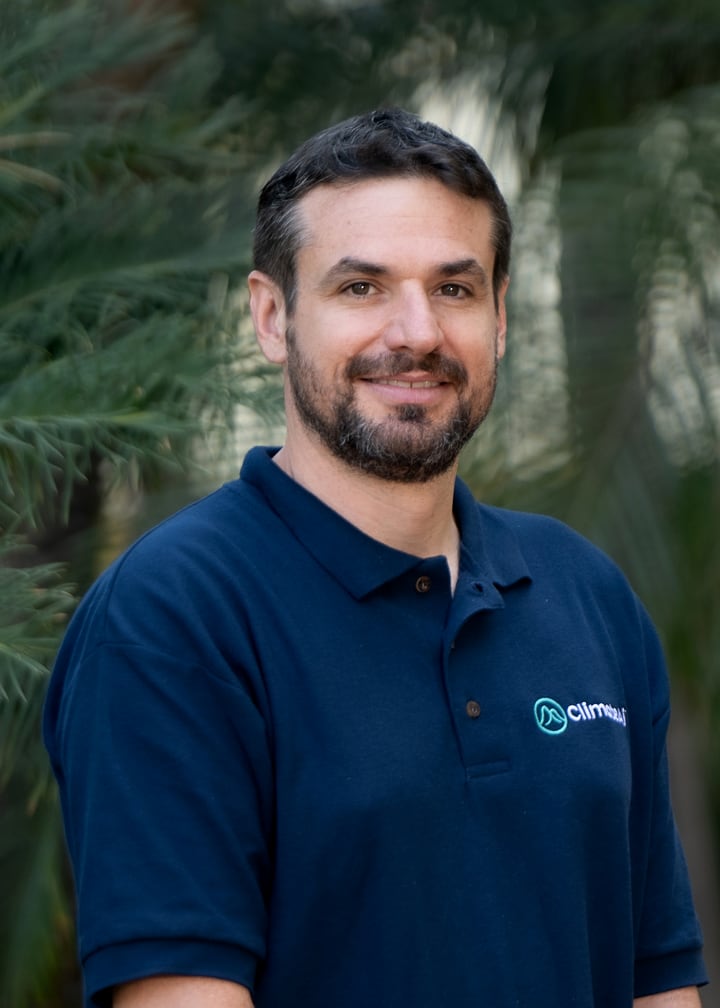
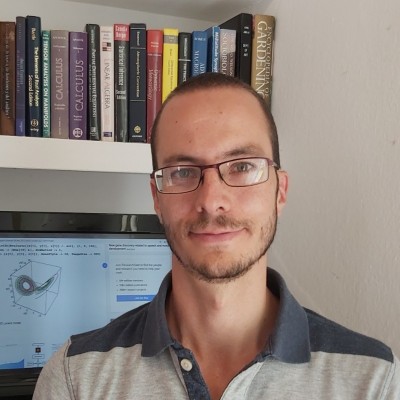
Diego Alfaro, founding partner at Ensemble.

Diego Alfaro, PhD

Founding Partner

  • Former Director of Product, ClimateAi
  • Former researcher and professor, UNAM · PhD, Stony Brook University
  • Founder, Climathics · former derivatives trader, BBVA

Diego's work combines deep scientific and quantitative expertise with a consistent focus on applying it to business and socially meaningful decisions.

  • Led Product company-wide at ClimateAi, setting strategy and priorities and working directly with customers, scientists, engineers, and commercial teams to turn complex technical capabilities into business value.
  • Led the scientific definition of ClimateAi's climate-risk indices and crop-yield models, advising global agriculture and food companies on how to interpret the results and their implications for business decisions.
  • Founded Climathics to build Mexico's first national operational corn-yield forecasting system, bringing state-of-the-art climate and statistical modeling into operational agricultural forecasting.
  • Expert in risk management, with first-hand experience as a derivatives trader and structurer at BBVA, applying quantitative analysis and probabilistic reasoning to investment and hedging decisions.
  • Full-time researcher and professor at UNAM focused on severe storms and weather risk, developing physically meaningful metrics to better characterize the severity and potential impact of extreme events.

Areas of focus

  • Atmospheric science
  • Crop-yield forecasting
  • Weather-risk indices
  • Forecast verification
  • Machine learning
  • Financial risk
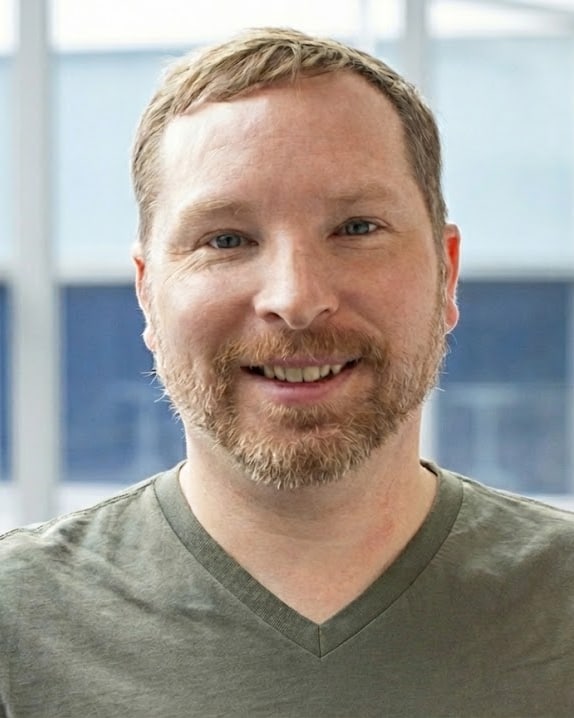
David Farnham, founding partner at Ensemble.

David (Dave) Farnham, PhD

Founding Partner

  • Former VP of AI and Engineering, ClimateAi
  • Former research scientist, Carnegie Science and Stanford
  • PhD, Columbia University

David is an applied scientist and technology executive focused on turning probabilistic climate and AI science into confident decisions for executives, customers, and stakeholders of every technical background.

  • Led AI and Engineering company-wide at ClimateAi, a twelve-person organization spanning data science, AI/ML, software and geospatial engineering, product, and Earth sciences, after four promotions in five years, with 100% voluntary retention among his hires.
  • Worked directly with dozens of enterprise and government customers, Fortune 500 companies and federal agencies among them, on hurricane-driven demand planning, power reliability, supply-chain risk, and agricultural exposure, turning bespoke analyses into repeatable products and cutting delivery times from weeks to hours.
  • Delivered work that stood up to outside scrutiny: a U.S. defense and logistics program closed with a government success memorandum confirming hurricane insight beyond existing federal sources, and a global technology customer publicly validated the forecasts and built internal tooling on them.
  • Represented ClimateAi in executive-level discussions of technology, product, and strategy with enterprise customers, government stakeholders, investors, academic partners, and prospective acquirers.
  • Authored 50+ peer-reviewed publications on climate risk to water and energy systems, including a World Bank working paper on prioritizing power-system resilience investments. PhD with Upmanu Lall at Columbia and postdoc with Ken Caldeira at Carnegie Science and Stanford, with his work covered by WIRED, The Independent, E&E News, and Bloomberg Intelligence, and explained live on national television.
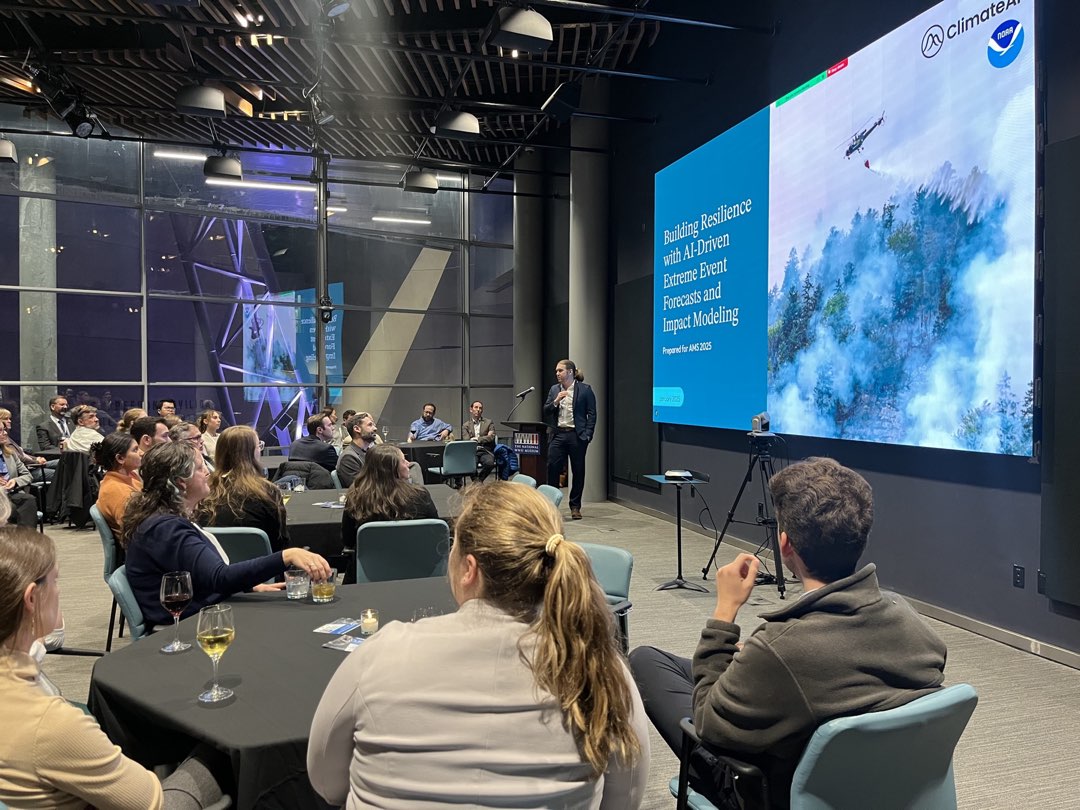
David Farnham presenting AI-driven extreme-event forecasting to a seated audience at the American Meteorological Society Annual Meeting, with a ClimateAi and NOAA slide on screen.
David presenting AI-driven extreme-event forecasting at the American Meteorological Society Annual Meeting, 2025. The same work gets explained to research audiences, executives, and boards, in whatever language the room needs.

Areas of focus

  • Climate risk
  • AI and machine learning
  • Probabilistic forecasting
  • Water and energy systems
  • Decision support
  • Scientific communication
Isaac Gerg, founding partner at Ensemble.

Isaac Gerg, PhD

Founding Partner

  • Former Applied AI Scientist, ClimateAi
  • Two decades of applied machine learning for the Navy, DARPA, ONR, and NATO
  • PhD in electrical engineering, Penn State

Isaac is a scientist who builds weather intelligence that operators can actually use. He helps organizations that live with weather risk, from retail and supply chains to agriculture, logistics, and defense, know what the forecast is worth, where it fails, and how to use it in planning.

  • Most recently at ClimateAi, designed methods that improved operational and seasonal forecasts against the systems customers already receive, not just raw models, and translated that skill into business value.
  • His weather-informed consumer-demand work, published in the Journal of Retailing and Consumer Services, cut consumer-spending forecast error by 11.5% on average and by more than 60% in some locations.
  • Built the verification, QA, and cost-loss tools that show when a forecast is good enough to act on.
  • Spent two decades applying machine learning to hard physical sensing problems for the Navy, DARPA, ONR, and NATO: fourteen years as research faculty at the Penn State Applied Research Laboratory, with roles at Kitware, Raytheon, and NATO's Centre for Maritime Research and Experimentation. Holds a PhD in electrical engineering from Penn State, with more than fifty publications.

Areas of focus

  • Machine learning
  • Physics-informed modeling
  • Probabilistic forecasting
  • Forecast verification
  • Remote sensing
  • Signal processing
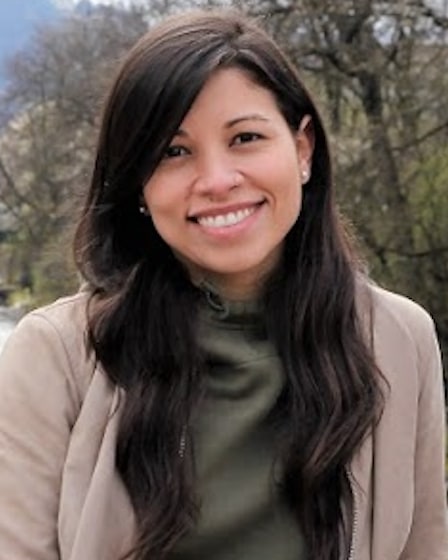
Laura Herrera, founding partner at Ensemble.

Laura Herrera, PhD

Founding Partner

  • Former Staff Data Scientist, ClimateAi
  • Former Lead, Air Quality and Boundary-Layer Meteorology, SIATA
  • PhD, Universidad Nacional de Colombia

Laura is an atmospheric scientist and data scientist specializing in boundary-layer meteorology, turbulence, and air quality. She combines scientific research with hands-on experience building commercial climate-risk and forecasting products, designing monitoring networks, and communicating environmental risk to communities and decision-makers.

  • At ClimateAi, built Adapt, the long-term climate-risk product, and developed climate-related assessments tailored to the needs of growers, investors, and supply-chain managers. Her work connected climate data and modeling with practical questions about exposure, risk, and long-term planning. She also built the back-end engine for the alerting system, combining observational data with ensemble forecasts.
  • As a consultant, developed forecasting models for reservoir inflows, energy demand, and renewable-energy prices. In separate projects, developed forecasts of fire potential, conducted climate-risk assessments for insurance applications, and helped develop insurance products.
  • Led the Air Quality and Boundary-Layer Meteorology team at SIATA, the early-warning system serving Medellín and the Aburrá Valley, for eight years. Oversaw a 40-site network combining in-situ measurements and ground-based remote sensing, alongside eddy-covariance towers measuring energy fluxes in complex terrain. Developed operational tools for analysts and worked with environmental authorities to develop air-quality policy.
  • Led the technical development of Citizen Scientist, the Aburrá Valley's community air-quality network, expanding it to more than 250 low-cost sensors alongside its outreach program. Communicated air-quality risks to residents, public officials, and technical teams, connecting neighborhood-level measurements with public understanding.
  • Has taught environmental data analysis and air pollution at Universidad EIA since 2020, in Lecturer and Assistant Professor roles. Co-advised MSc theses on aerosols, atmospheric dispersion, and radiative processes.
  • Published research on extreme events, atmospheric stability, boundary-layer depth, and pollution in tropical valleys. Her doctoral work, completed with meritorious distinction, included research at the University of Innsbruck through an Ernst Mach Grant.

Areas of focus

  • Boundary-layer meteorology
  • Air quality
  • Turbulence
  • Monitoring network design
  • Reservoir inflows
  • Energy demand
Carlos Hoyos, founding partner at Ensemble.

Carlos Hoyos, PhD

Founding Partner

  • Former Senior Staff Data Scientist, ClimateAi
  • Former Director and Chief Scientist, SIATA
  • Former seasonal-outlook lead for Colombian hydropower · PhD, Georgia Institute of Technology

Carlos is an atmospheric scientist applying climate science and machine learning to energy, agriculture, insurance, and public safety. His work combines scientific research and product development with public-sector leadership, communication with decision-makers, and education.

  • Led scientific work across ClimateAi's commercial products and built Adapt and the ClimateAi Agent, working with customers and engineers from problem definition through deployment. Developed downscaling from 25 km to 1 km, supported by more than 120,000 quality-assessed data sources, and ROI analyses connecting climate projections to business decisions.
  • Directed SIATA, Medellín and the Aburrá Valley's early-warning system, growing the organization from three people to more than 150. Led an in-house monitoring network of 300+ sensors and ten operational models supporting utilities, government, and emergency responders.
  • Led seasonal outlooks for hydropower planning and reservoir management in Colombia and contributed to Bangladesh's three-tier flood-forecasting system. Ran an applied-research consultancy for thirteen years, serving energy and insurance clients.
  • Advised public institutions, served on boards, and presented to mayors, city councils, governors' offices, and regulators. Regularly appeared on national television and radio during emergencies, explaining forecast uncertainty and its implications for public safety and operational decisions.
  • Professor at Universidad Nacional de Colombia for fifteen years, supervising 50 students to completion and designing graduate curricula. Founded SIATA's citizen-science program, placing instruments in 300 households and schools, and its STEM program, reaching more than 8,000 learners and 200 teachers.
  • Authored 42 peer-reviewed papers, including first-author work in Science; reviewed manuscripts for Nature and research proposals for the NSF and NOAA.
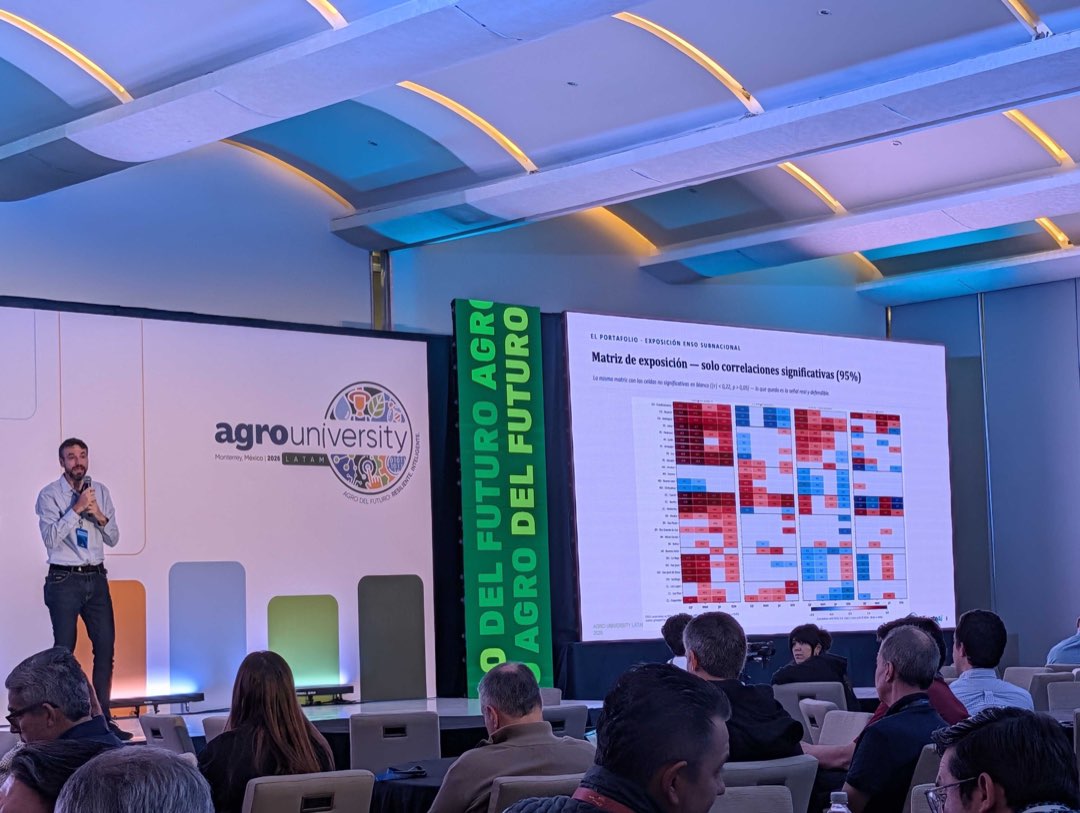
Carlos Hoyos presenting a subnational ENSO exposure matrix to a seated audience at Agro University LATAM in Monterrey, Mexico.
Carlos briefing agricultural and commercial teams on subnational ENSO exposure at Agro University LATAM, Monterrey, 2026: the seasonal climate signal, explained in the room's own language.

Areas of focus

  • Tropical meteorology
  • Seasonal forecasting
  • Hydropower
  • Reservoir management
  • Early-warning systems
  • Risk communication
Arik Tashie, founding partner at Ensemble.

Arik Tashie, PhD

Founding Partner

  • Former Senior Staff Data Scientist, ClimateAi
  • Advised Fortune 500 companies on water risk across five continents
  • PhD in hydrology, UNC Chapel Hill

Arik is a hydrologist and data scientist specializing in groundwater, drought, low flows, reservoirs, flooding, and scalable environmental modeling.

  • Advised Fortune 500 companies and smallholder farmers on water risk across five continents, guiding resource-management strategies and capital planning.
  • At the US EPA, co-developed sustainability programs with business and government partners, and developed green-infrastructure plans for municipalities.
  • Holds a PhD in hydrology from UNC Chapel Hill, with fifteen peer-reviewed papers, including Hydrological Processes' M.G. Anderson Editors' Choice Award for Outstanding Paper of the Year.
  • Developed novel, globally applicable physics-informed neural-network flood and wildfire forecasting tools.
  • At ClimateAi, deployed predictive models for commodity futures, energy prices, and supply chains, including a near-real-time global reservoir-monitoring system serving publicly traded companies, NGOs, and federal agencies.
  • Produced, in research with NOAA's National Water Center, a calibration-free groundwater module improving low-flow and drought prediction at national scale.

Areas of focus

  • Hydrology
  • Groundwater
  • Drought and low flows
  • Reservoirs
  • Flooding
  • Remote sensing

Collective expertise

One integrated team across climate, water, technology, and decisions

Engagements draw on whatever the question requires, and we say at the outset who will do the work.

  • Climate and weather

    What the climate has done, what it may do, and how much of that signal is trustworthy at the horizon you need.

    Capabilities

    • Climate projections
    • Seasonal and subseasonal forecasting
    • Weather-risk indices
    • Forecast verification
    • Uncertainty analysis
  • Water

    Surface water, groundwater, and the storage and extremes between them, from basin behavior to site-level indicators.

    Capabilities

    • Water availability
    • Drought and low flows
    • Groundwater
    • Reservoirs
    • Flooding and inundation
  • Agriculture and commodities

    Weather and climate connected to crops, growth stages, producing regions, and the sourcing decisions built on them.

    Capabilities

    • Crop-weather relationships
    • Crop-yield forecasting
    • Commodity exposure
    • Sourcing-region analysis
    • Seasonal outlooks
  • Energy and infrastructure

    Resource variability, weather-driven demand, and the assets that have to absorb both.

    Capabilities

    • Hydropower
    • Renewable-resource variability
    • Weather-driven demand
    • Infrastructure exposure
  • AI, data, and product

    The engineering that turns a method into something that runs reliably, is validated, and can be handed over.

    Capabilities

    • Machine learning
    • Geospatial analytics
    • Model development and deployment
    • Data pipelines
    • Decision-support tools
  • Risk and value

    Where the analysis meets the decision: who uses it, what changes, and how uncertainty is communicated.

    Capabilities

    • Financial risk
    • Scenario analysis
    • Reporting
    • Communication of uncertainty
    • Risk-to-value mapping

Where it gets applied

The same expertise, pointed at seven kinds of question

Each area draws on whichever partners the question needs. The questions themselves are listed with each service.

  • Reporting and scenario analysis

    Physical climate risk represented defensibly in internal and external reports, across scenarios and horizons.

  • Water availability and drought

    Scarcity likelihood, low flows, groundwater, and reservoir conditions for operations that depend on water.

  • Flood and extreme precipitation

    Inundation exposure and extreme-rainfall frequency for sites, infrastructure, and insurance questions.

  • Agriculture and commodity exposure

    Crop-weather relationships, yield outlooks, and sourcing-region risk for growers, buyers, and traders.

  • Energy and infrastructure planning

    Hydropower, weather-driven demand, renewable variability, and asset exposure over planning horizons.

  • Supply chains and operational resilience

    Supplier and facility exposure to the hazards that interrupt production and logistics.

  • Model validation and technical review

    Independent assessment of models, vendor outputs, and forecasts before they carry a decision.

Next step

Work directly with the people who produce the analysis

There is no account layer between you and the science. Tell us what you are trying to decide, report, or verify, and one of the six of us will reply.

Discuss a project